
Assessing Political Shockwaves and Market Uncertainty: What the Reported US Action in Venezuela Could Mean
A rapidly unfolding situation with contested details
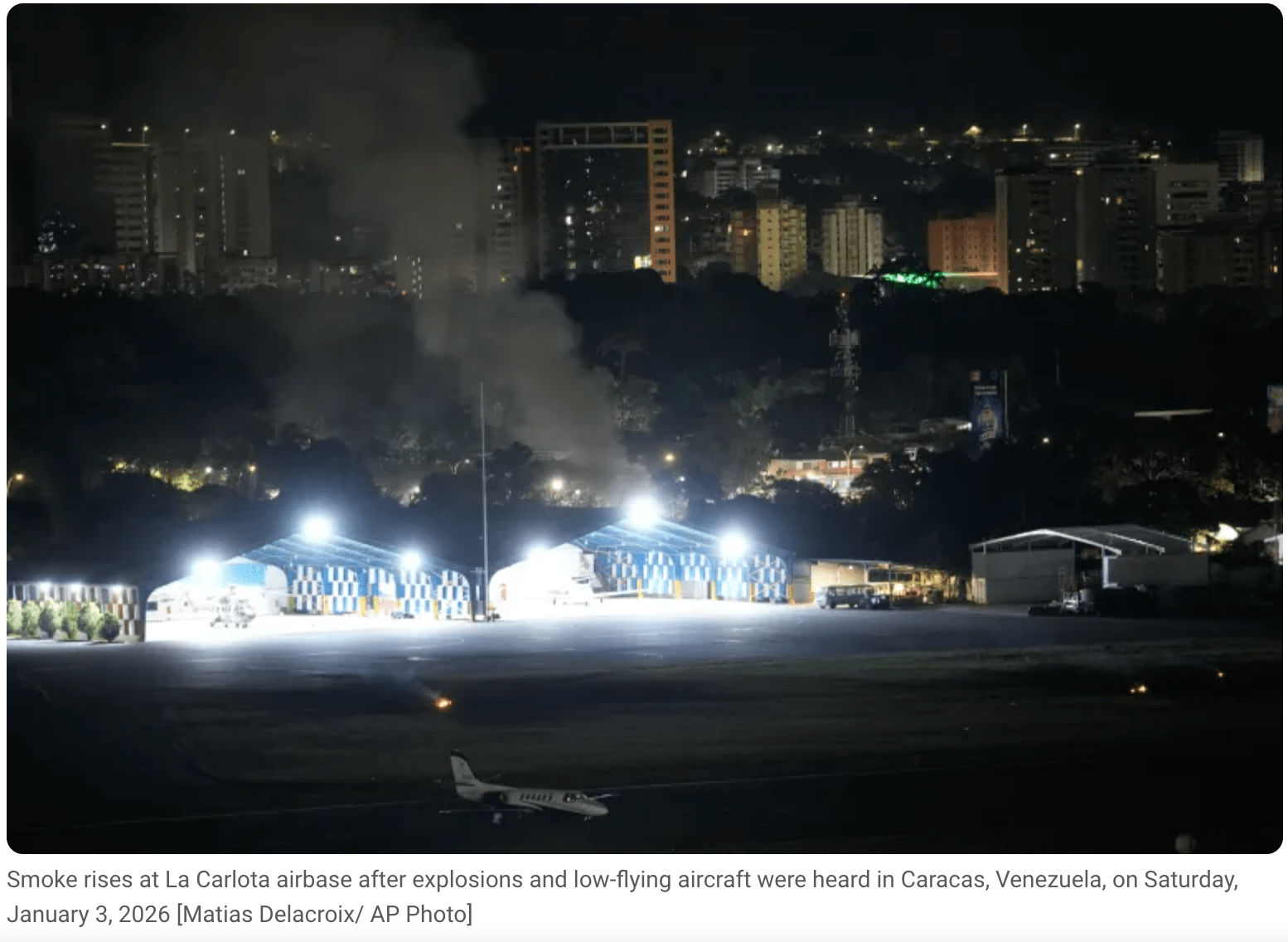
A dramatic set of events has been reported around Venezuela following overnight explosions in and around Caracas and subsequent statements from the United States and Venezuelan officials. According to the information provided, at least seven explosions were reported in Caracas at about 2am local time, with residents describing low-flying aircraft. One explosion was reported to have appeared to come from near Fort Tiuna, described as the main military base in the Venezuelan capital.
In the hours that followed, United States President Donald Trump stated that US forces had bombed Venezuela and captured Venezuelan President Nicolas Maduro and First Lady Cilia Flores. Trump posted an image he said showed Maduro on board the USS Iwo Jima and later said the US would “run the country” until a “judicious” transition of government could be made. Venezuelan authorities, however, had not confirmed that Maduro was taken by US troops, while also not directly denying the claim in the material provided.
What Venezuelan officials have said about Maduro’s whereabouts
Venezuela’s vice president, Delcy Rodrigues, told state-owned VTV that the government had lost contact with Maduro and Flores and did not have clarity on their whereabouts. She demanded that the US provide “proof of life” and said Venezuela’s defenses were activated. Separately, the Venezuelan government issued a statement rejecting, repudiating, and denouncing the attacks, arguing that the aggression threatened regional stability and put millions of lives at risk.
From a risk perspective, uncertainty over the whereabouts of a head of state and the immediate chain of command can become a central driver of instability. The information provided notes that constitutionally, the vice president is next in line to take charge if Maduro is no longer in place. Still, it remains unclear how the broader state apparatus—built over decades—would function under sudden leadership disruption.
US communications and the timeline of public confirmation
Before the reported explosions, the US Federal Aviation Administration issued instructions to US commercial airlines to stay clear of Venezuelan airspace. After the blasts, the US Embassy in Bogota referenced reports of explosions and advised American citizens to stay out of Venezuela, but did not confirm US involvement at that time. Trump later claimed responsibility in a post made after the bombings, stating that Maduro and Flores had been captured and flown out of the country.
Trump said the operation was carried out in conjunction with US law enforcement, without specifying who led it. Additional statements mentioned a news conference at Trump’s Mar-a-Lago residence, where he said more details would be revealed. The Venezuelan government reported strikes in Caracas and the states of Miranda, Aragua, and La Guaira, while Colombia’s president, Gustavo Petro, listed additional locations he said had been hit.
Why the episode is being compared to rare historical precedents
The material provided describes the operation as having few parallels in modern history. It notes that the US has previously captured foreign leaders such as Iraq’s Saddam Hussein and Panama’s Manuel Noriega, but only after invading those countries in declared wars. In this case, the reported capture and strikes are presented as occurring amid rising tensions rather than within the framework of a declared war.
Questions about legality are also raised in the provided content, which states that attacks on Venezuela violate UN Charter principles of sovereignty and territorial integrity. It also notes that US officials remained silent on the illegality of the capture and the attacks, as characterized in the text.
Drivers of escalation: narcotics claims, sanctions, and maritime action
The information provided outlines months of mounting pressure. Trump has accused Maduro of driving narcotics smuggling into the US and claimed Maduro is behind the Tren de Aragua gang, which Washington has proscribed as a foreign terrorist organization. However, the content also states that US intelligence agencies said there is no evidence linking Maduro to Tren de Aragua, and that US data shows Venezuela is not a major source of contraband narcotics entering the country.
Starting in September, the US military reportedly launched strikes on boats in the Caribbean Sea it claimed were carrying narcotics. The provided material says more than 100 people have been killed in at least 30 such boat bombings, while also stating that the administration had not presented public evidence that drugs were on board, that the vessels were traveling to the US, or that the people on the boats belonged to banned organizations.
In parallel, the US began what is described as its largest military deployment in the Caribbean Sea in decades, spearheaded by the USS Gerald Ford. In December, the US hijacked two ships carrying Venezuelan oil and imposed sanctions on multiple companies and tankers accused of trying to circumvent existing sanctions on Venezuela’s oil industry. Trump also described a recent US strike on what he called a Venezuelan “dock” where drugs were allegedly loaded onto boats.
Oil, infrastructure, and competing claims about ownership
Oil features prominently in the provided account of the political backdrop. Trump said US oil companies would “go in and spend billions of dollars” to fix Venezuela’s “badly broken oil infrastructure,” and claimed this would make Venezuelans “very rich, independent and safe.” The content also notes that some senior aides have been open about Venezuela’s oil reserves, which are described as an estimated 303 billion barrels as of 2023.
One adviser, Stephen Miller, is quoted as claiming the US “created the oil industry in Venezuela” and that Venezuela’s oil should therefore belong to the US. The provided material counters this by stating that international law is clear that sovereign states own natural resources within their territories under the principle of Permanent Sovereignty over Natural Resources, and that Venezuela nationalized its oil industry in 1976. It also notes that one major US oil company, Chevron, continues to operate in Venezuela.
For market observers, the combination of sanctions, potential leadership change, and stated intentions around oil infrastructure can intensify uncertainty. Even without forecasting outcomes, the reported emphasis on energy assets underscores why Venezuela’s political developments can be watched closely by those assessing regional stability and economic risk.
Regional and international reactions split along ideological lines
Reactions across Latin America described in the material appear divided. Colombia’s President Gustavo Petro rejected the “aggression against the sovereignty of Venezuela and Latin America” and called for an immediate UN Security Council meeting. Brazil’s President Luiz Inacio Lula da Silva said the bombings and capture crossed an “unacceptable line.” Chile’s outgoing President Gabriel Boric condemned the attack, while President-elect Jose Antonio Kast welcomed the news and called for regional governments to ensure the regime’s apparatus abandons power and is held accountable.
Argentina’s President Javier Milei expressed approval via videos posted to X, and Ecuador’s President Daniel Noboa wrote that “All the criminal narco-Chavistas will have their moment.” The content also states that Russia and Cuba condemned the attack, and that many other nations were relatively muted.
Public response: quiet streets, protests, and diaspora celebrations
In Caracas, streets were described as mostly quiet in the morning, patrolled by security forces as people stayed indoors. Later, supporters of Maduro’s government gathered to protest what they called his capture, with Caracas Mayor Carmen Melendez—wearing a military uniform—describing the US action as Maduro’s “kidnapping.”
At the same time, the material reports that many members of the Venezuelan diaspora celebrated in other countries. It cites United Nations International Organization for Migration data that about 20% of Venezuela’s population—around 7.7 million people—have left since 2014, with about 85% moving to neighboring countries in Latin America and to the Caribbean. Individual comments from Venezuelans in Chile and Spain are included in the provided content expressing joy and hope, alongside acknowledgement that conditions in Caracas may be difficult.
Legal proceedings and charges referenced by US officials
According to the provided material, US Attorney General Pam Bondi announced that Maduro and his wife had been indicted in the Southern District of New York. Maduro was said to face charges including “narco-terrorism conspiracy” and “cocaine importation conspiracy,” among others. The content also references a Republican senator reporting that Secretary of State Marco Rubio said Maduro had been arrested by US personnel to stand trial in the United States, and that force was used to protect those executing an arrest warrant.
The material notes that US prosecutors had charged Maduro in 2020 with running a cocaine-trafficking network.
Unclear succession and uncertain next steps
If Maduro is no longer able to govern, the provided content says the vice president is constitutionally next in line. It also lists other senior figures seen as influential, including Interior Minister Diosdado Cabello, National Assembly President Jorge Rodriguez, and military chief General Vladimir Padrino López. However, it remains uncertain whether the governing structure will hold without Maduro and his closest allies.
The opposition leader Maria Corina Machado has publicly called for US intervention against Maduro, and in a post said opposition colleague Edmundo Gonzalez should assume the presidency, adding that the opposition would restore order and free political prisoners. Yet the content also cites a November poll in Venezuela in which 55% opposed military intervention and an equal share opposed economic sanctions.
Key uncertainties that continue to shape the outlook
Whether Maduro and Flores are in US custody, and whether “proof of life” will be provided as demanded by Venezuela’s vice president.
The full list of locations struck and the scope of damage, given differing accounts and limited official detail in the provided material.
How leadership succession would function in practice, including the role of senior political and military figures.
How sanctions, oil infrastructure plans, and competing legal and sovereignty claims may influence near-term stability.
Whether sustained engagement would follow, with analysts quoted suggesting prolonged involvement could be required if major political change occurs.
With competing claims, limited confirmations, and strong regional reactions, the situation described remains fluid. What is clear from the provided information is that the combination of military action, leadership uncertainty, and the centrality of oil and sanctions has created a high-stakes environment with significant political and economic implications.