
Reports of US Operation in Venezuela Raise Questions Over Authority, Security, and Regional Stability
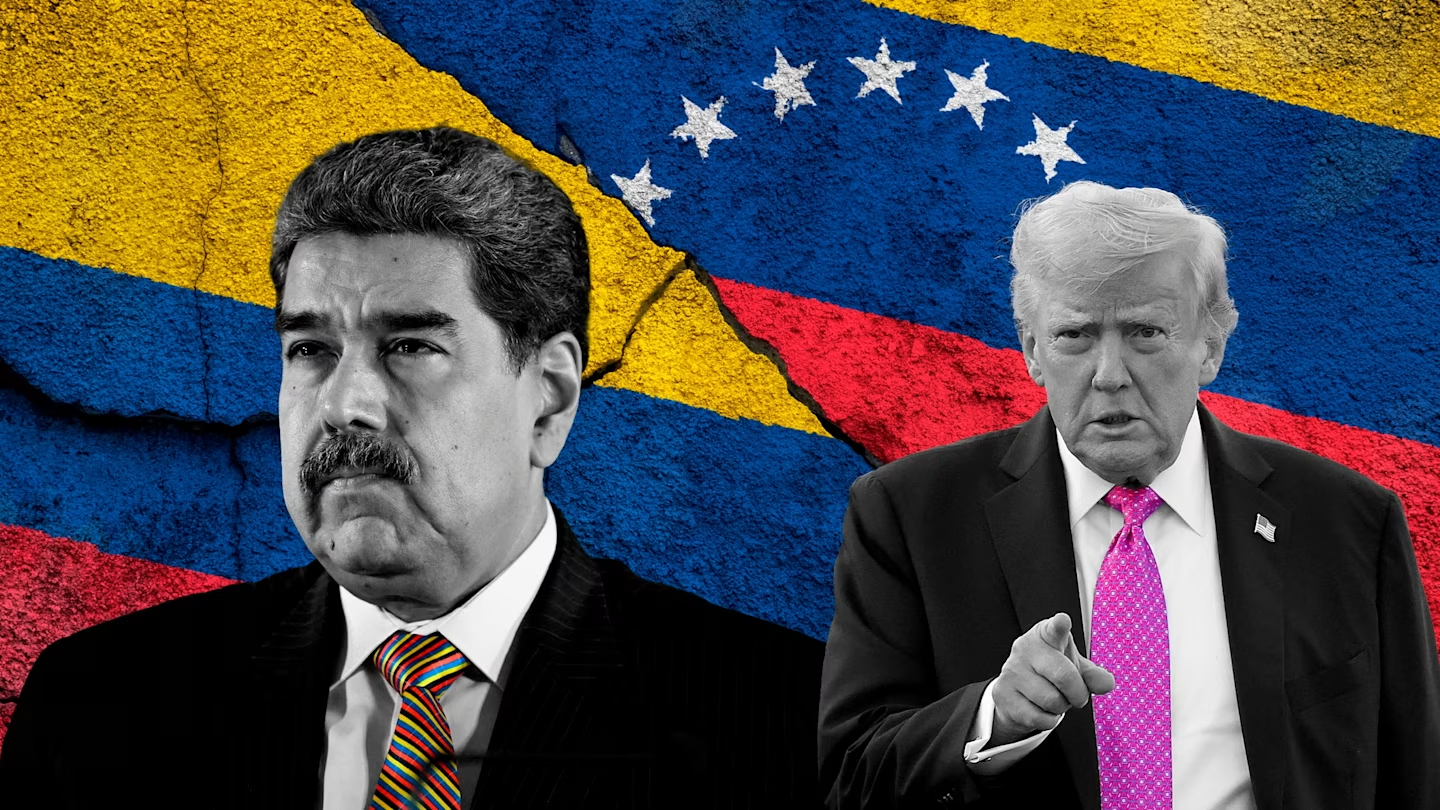
Trump claims Maduro and Flores were captured in pre-dawn assault
US President Donald Trump said the United States had “captured” Venezuela’s president, Nicolás Maduro, and his wife, Cilia Flores, and flown them out of the country during a pre-dawn assault on Caracas and surrounding areas. Witnesses in Venezuela reported a series of explosions as the operation unfolded.
Trump described the action as “a brilliant operation,” citing planning and the involvement of “great troops and great people.” He also wrote on social media that US troops had launched “a large-scale strike against Venezuela,” adding that more details would be announced at a press conference at his Mar-a-Lago residence in Florida.
CBS News reported US officials as saying Maduro had been captured by members of Delta Force, an elite army unit previously associated with the 2019 killing of Islamic State leader Abu Bakr al-Baghdadi.
US attorney general says couple will face criminal charges
US attorney general Pam Bondi said Maduro and Flores would face criminal charges and trial in the United States based on a 2020 New York indictment. In a social media post, she wrote that they would “soon face the full wrath of American justice on American soil in American courts.”
At the same time, key details remained unclear, including what legal and constitutional authority supported the military operation and the capture and trial of a sovereign head of state. It was also not clear whether Trump consulted Congress beforehand; Congress is supposed to be notified by the presidency before any declaration of war.
Explosions reported in Caracas; multiple sites said to be targeted
Venezuela’s government accused the United States of launching attacks against civilian and military targets after explosions rocked the capital before dawn on Saturday. The Associated Press reported that at least seven explosions were heard around 2am, and residents in various neighbourhoods rushed into the street.
One witness, Carmen Hidalgo, a 21-year-old office worker, described the experience: “The whole ground shook. This is horrible. We heard explosions and planes in the distance.”
Witnesses reported smoke pouring from two key military installations in Caracas: La Carlota military airfield and the Fuerte Tiuna military base, where Maduro has long been thought to live. Another airport east of Caracas, Higuerote, also appeared to come under attack.
In its statement, Venezuela’s government confirmed three other states had come under attack: Miranda, La Guaira and Aragua.
Venezuelan officials seek proof of life and warn of casualties
Speaking on Venezuela’s state-run television channel, Vice-President Delcy Rodríguez appeared to confirm the capture of Maduro and Flores, saying she did not know where they were. Rodríguez demanded immediate “proof of life” for the couple and accused the United States of “murdering humble and innocent Venezuelan men and women.”
“At this moment Venezuela is calm, absorbing the significance of a military aggression of this nature,” she said in a brief telephone interview.
It remained unclear who was in charge of Venezuela in the president’s absence. Interior minister Diosdado Cabello appeared in a video on state TV flanked by police officers, assuring citizens the situation was stable. Wearing a bulletproof vest and tactical helmet, Cabello said the military forces, police forces, and the people were prepared “for any situation,” and for any attempt “to go further than the cowardly attacks” carried out against the country’s forces and its people.
In a separate defiant online video, Venezuela’s defense minister, Gen Vladimir Padrino López, accused the United States of conducting a “deplorable” and “criminal” regime change operation. He said authorities were still trying to calculate how many civilians had been killed or injured during helicopter attacks on urban areas, and called on citizens and soldiers to unite in resistance.
International reaction: condemnation, alarm, and calls for UN action
The bombardment and the reported capture of a foreign head of state shocked the international community, which reacted with alarm. Neighbouring Colombia condemned the attack, called for an immediate emergency session of the UN security council, and said it was preparing to receive a “massive influx of refugees.”
The UN special rapporteur on human rights and counter-terrorism, Ben Saul, said Trump should be investigated for the operation. “I condemn the US’s illegal aggression against Venezuela and the illegal abduction of its leader and his wife. Every Venezuelan life lost is a violation of the right to life,” Saul said.
Cuba’s president, Miguel Díaz-Canel, denounced what he called a “criminal attack,” writing that the region was being “brutally assaulted” and describing it as “state terrorism” against Venezuela and the wider region.
Context: months of pressure, strikes, and maritime actions
The United States has run a five-month pressure campaign against Maduro, which many analysts believe has been aimed at toppling him. Since August, Trump has ordered a massive military buildup off Venezuela’s northern coast and conducted a series of deadly airstrikes on supposed “narco boats.”
Trump has repeatedly threatened to launch land operations in Venezuela, amid other efforts to pressure Maduro to leave office, including expanded sanctions and an increased US military presence in the region. The report also described more than two dozen strikes on vessels allegedly involved in trafficking drugs in the Pacific Ocean and Caribbean Sea.
Legal experts have said some of the US strikes on suspected drug trafficking vessels could amount to war crimes. At least 110 people have been killed by the strikes so far.
The US has also seized sanctioned oil tankers off the coast of Venezuela, and Trump ordered a blockade of others in a move that seemed designed to tighten pressure on the country’s economy.
Claims over targets and motives intensify political stakes
Colombia’s president, Gustavo Petro, published what he claimed was a partial list of bombed installations, including the 19th-century national assembly building in Caracas, La Carlota airbase, and an air force base in the city of Barquisimeto.
Other reputedly targeted sites included the Cuartel de la Montaña barracks in Caracas, described as home to the mausoleum of Hugo Chávez, Maduro’s mentor. The mausoleum was characterized as one of the most sacred locations for Chavismo, the political movement that has governed Venezuela since Chávez came to power in 1999.
Venezuela’s government said the “only objective” of the attack was to seize control of Venezuela’s strategic resources, “in particular its oil and minerals,” and called on the international community to denounce what it described as a flagrant violation of international law that put millions of lives at risk.
Key uncertainties remain
The legal and constitutional authority for the operation, and whether Congress was consulted in advance.
The location and condition of Maduro and Flores, as Venezuelan officials demanded “proof of life.”
Who is exercising executive control in Venezuela during the president’s absence.
The scale of casualties and damage, as Venezuelan authorities said they were still assessing deaths and injuries.
Potential regional consequences, including Colombia’s warning of a possible “massive influx of refugees.”
As governments and international bodies react, the situation remains fluid, with competing claims and unanswered questions about the operation’s scope, legality, and humanitarian impact.